
Measuring Moisture
Measuring moisture with and without a fancy meter

A few posts back we talked about wood moisture. That post covered basic wood moisture theory surrounding how wood dries out and reaches an equilibrium. For a woodworker understanding that theory is extremely important. Once we understand how wood moisture behaves we then need a way to measure it.
There are three main methods to measure wood moisture content.
Pin meters
Pinless meters
Oven test
I am going to walk through all three so you can hopefully make an informed decision on which method is best for your workflow.
Oven Test
The oven test is the most accurate form of moisture measurement and it is on the principles of the oven test that moisture content (MC) is predicated on. To refresh our memory lets run though again how MC % is calculated.
MC is calculated by taking the weight of the water in the sample divided by the dry (bone dry zero water) weight of the wood cellulose multiplied by 100 for the MC%. let’s say a 100gram wet sample after being taken to bone dry weighs now 82.5 grams that was 17.5 grams of water. 17.5 grams of water divided by 82.5 grams of cellulose ×100 would be 21.2% moisture.
Oven testing is the industrial standard and certified kiln operators use the oven test to do their final moisture checks by pulling sacrificial sample boards from each kiln load and performing oven tests on pieces cut from the middle of those sample boards.
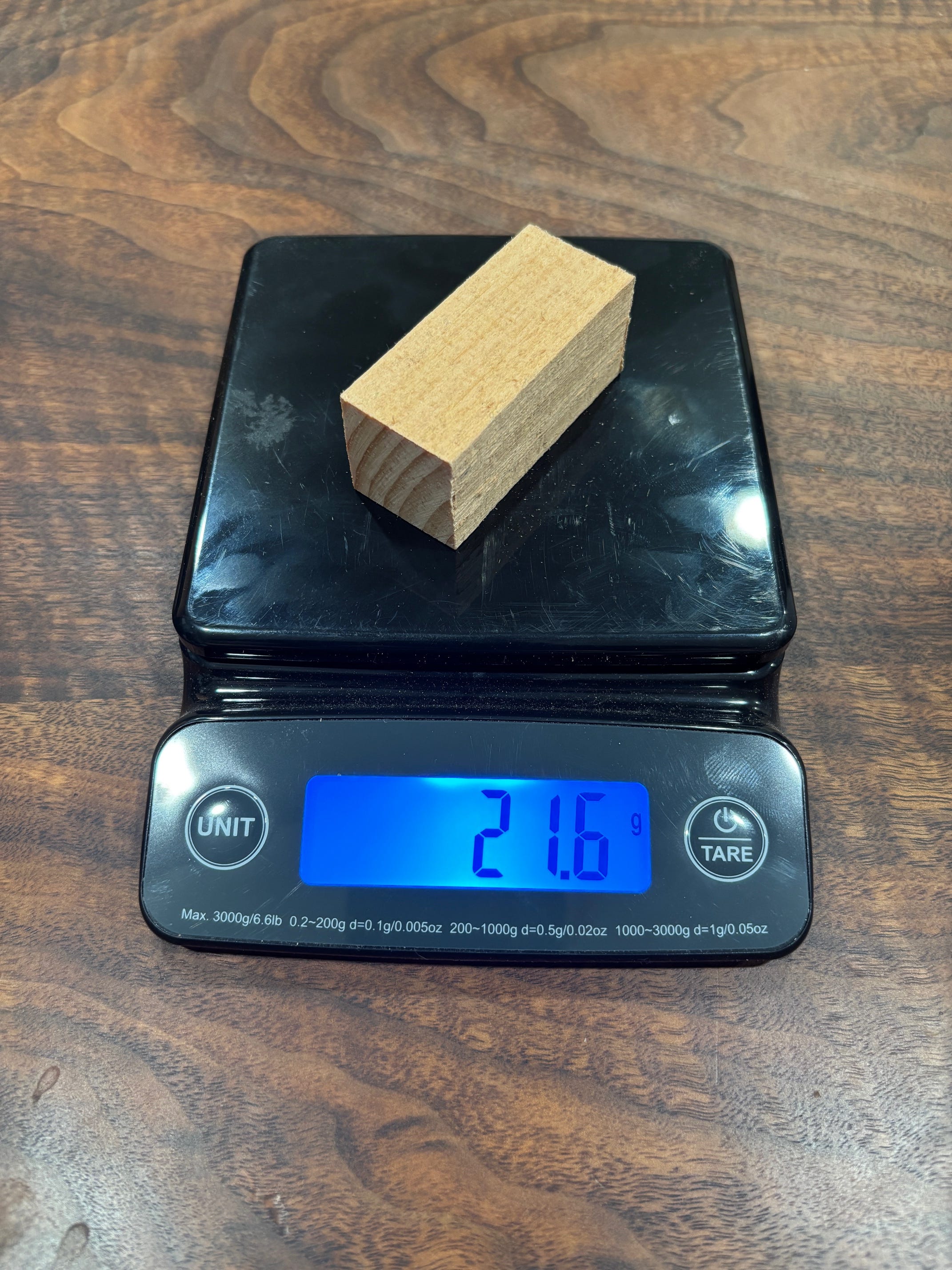
To perform an oven test you will need a small kitchen scale that measures in grams and you home microwave or oven.
Begin by cutting a sample from the board. Ideally the sample should be 24” from the end of the board as boards dry out more rapidly from the end grain. Your sample will be very small with the ideal size being about 1”x1” cross section 2” of length with the grain. Once cut, knock off any fuzz or dust as this falling off in the oven will affect weights. Then take an initial wet weight, it’s important to take this first weight immediately, as after being exposed to the air a sample this small will immediately start drying out.
Now place your sample in a conventional oven (or better yet a laboratory oven) at 212-221 degrees F removing every 20min and checking weight until the sample stops losing moisture. This can also be done in the microwave. I run the microwave for 1-2min cycles and let the piece cool after each cycle. Stand close by and watch carefully as you can easily set the sample on fire. In both a microwave and a home conventional oven. Once your sample has stopped losing weight and cooled you will take the bone dry or oven dry weight and run the calculation outlined above.
This is the most accurate method to measure wood MC
Pin Meters
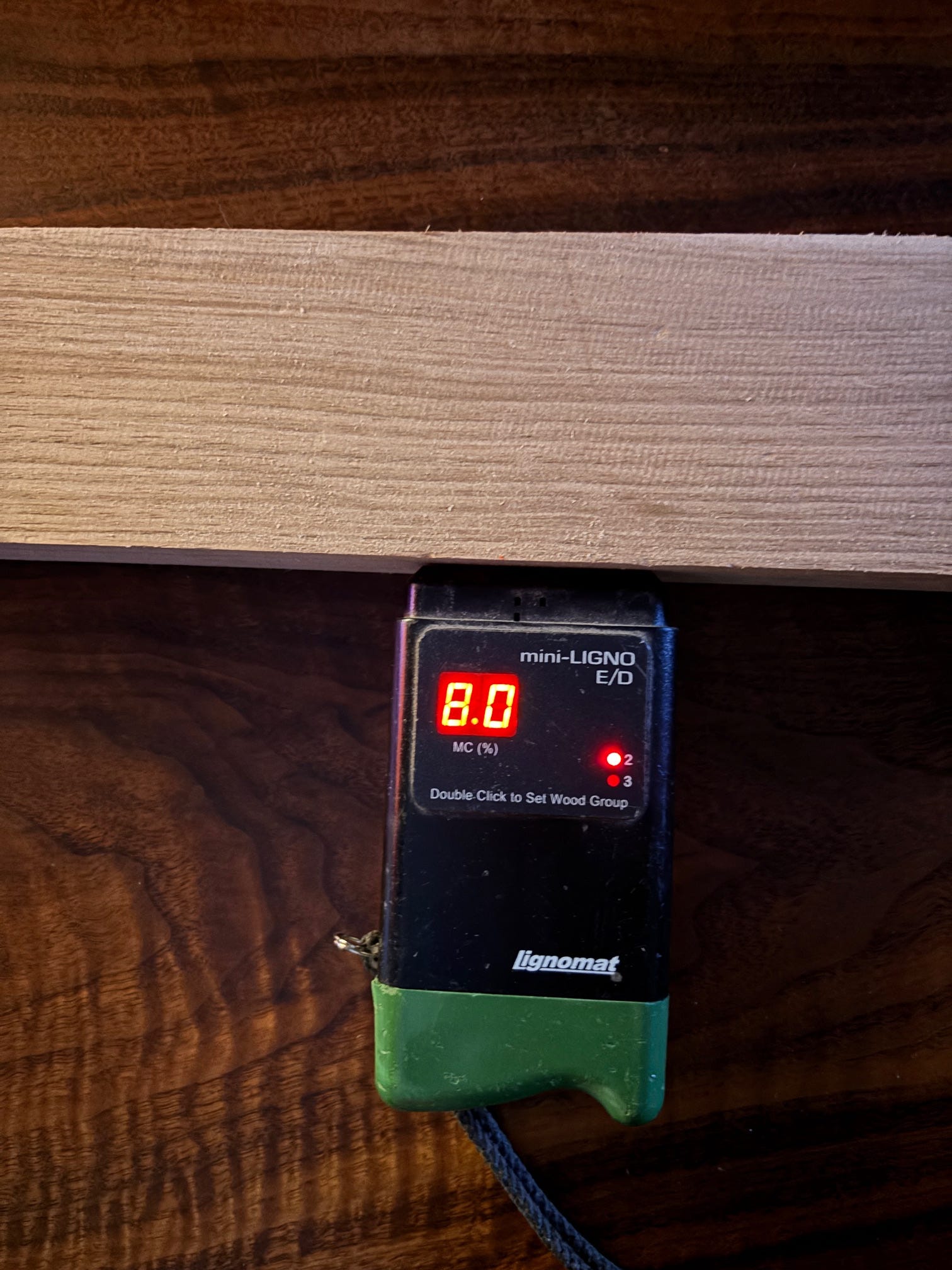
Next we have pin meters. These meters have small metal test pins that are pressed into the wood and an electronic pulse is sent between the pins to measure resistance. The higher the moisture the less resistance. These meters group different species according to Specific Gravity so they need set based on the wood species.
Pin meters are only accurate as deep as the pins penetrate. Making most pin meter setups only able to read moisture ⅛-5/16” deep into the wood. This makes these meters worthless unless you saw open a sample to expose the core or you purchase a slide hammer setup with long pins.
When these meters are used they are most accurate when the pins are inserted parallel to the longitudinal axis of the wood.
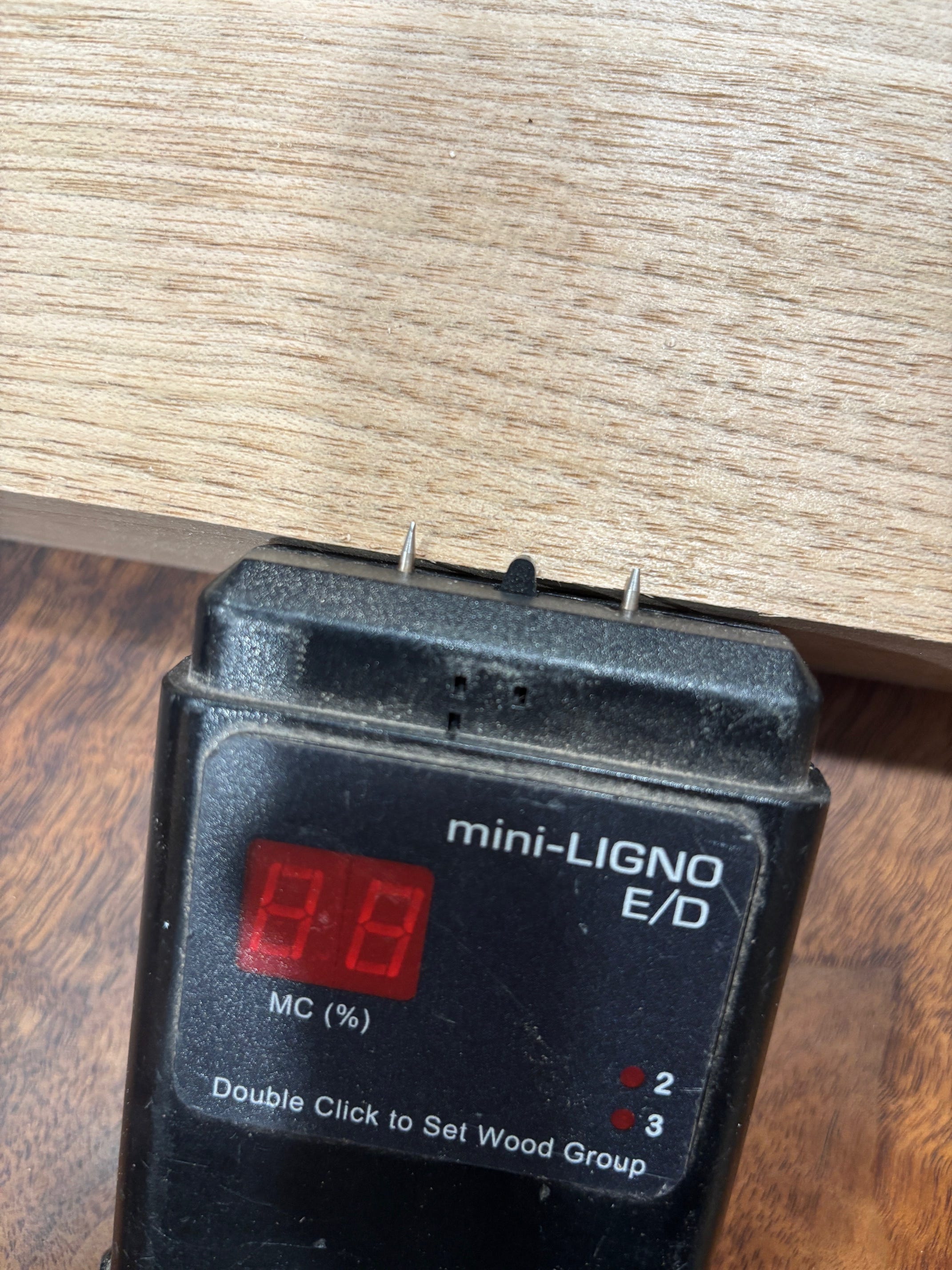
For a pin meter I would recommend Lignomat or Delmhorst; these are the industry leading manufacturer used in commercial wood drying. Both of these manufacturers have replaceable pins of different lengths as well as slide hammer attachments. You can also send off your meter for calibration.
Pinless Meters
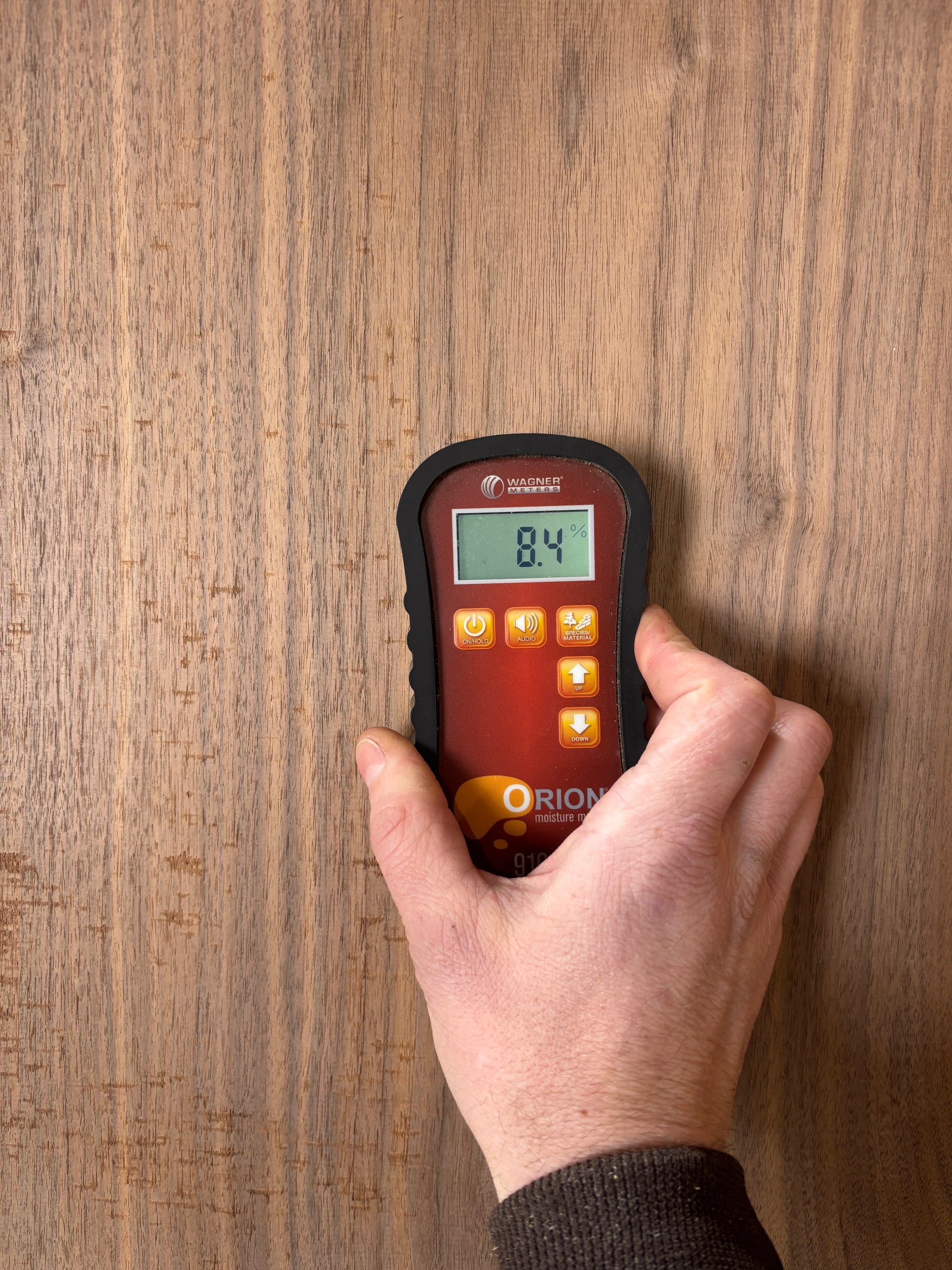
Pinless meters are expensive but they are by far the most handy to keep close by for a quick check or to take to the lumberyard to spot check without filling someone else’s wood full of holes (I’ve had customers do this. Don’t be an asshole.).
Pinless meters have a sensor pad on the back of the meter that emits a low electromagnetic frequency signal that measures the wood’s dielectric constant.
There are different pinless meters that read different depths so you will want one that reads ¾” deep if you want to confidently check moisture on 8/4 material.
When using a pinless the meter must be placed inline with the length of the grain for an accurate reading. Pinless meters use specific settings for each specie’s specific gravity giving it a species specific accuracy. It is important however that the surface of the board be dry as surface water can throw off its reading.
I personally use a Wagner Orion 910. These meters are an investment and can save you thousands of dollars in frustration especially if you are buying lumber from backyard sawyers.
I hope this overview gets you off on the right foot on measuring moisture. As always don’t hesitate to comment with questions. And remember the right moisture content is different based on the usage and the environment the wood is getting used.
PS: my recommendations are based on experience and tools I have purchased. I am in no way sponsored by these meter companies.
Thanks Shea. You increased my understanding of moisture meters with most useful information. I have a Lignomat.
Cheers,
Michael