
Wood Moisture
How its calculated and how dry is dry enough

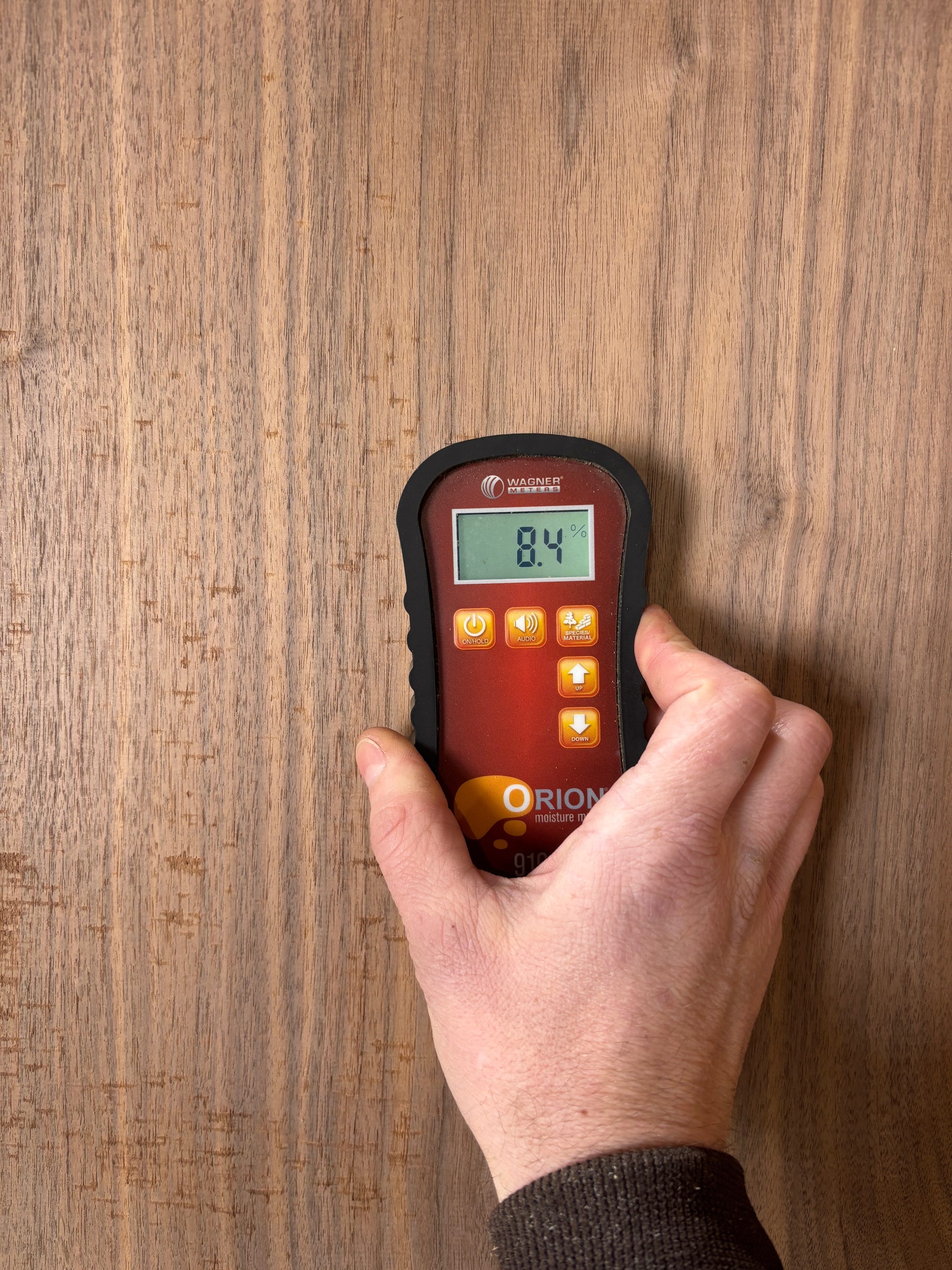
In Grade School biology you probably remember being told our bodies are mostly water. The same can be said for many trees. But what does that mean for lumber and for woodworking?
Moisture Content (MC%)
A tree’s vast root system draws water from the ground and their fibers (cellulose) absorb that water until they are saturated, then the wood structure’s pores and cell cavities (lumens) fill up with water as well. When the weight of all that water is more than the weight of the wood cellulose the moisture content (MC) of the tree is over 100%. Fresh sawn Eastern White Pine for example is often 175% moisture.
Let me explain MC mathematically for a second. MC is calculated by taking the weight of the water in the sample divided by the dry (bone dry zero water) weight of the wood cellulose multiplied by 100 for the MC%. let’s say a 100gram wet sample after being taken to bone dry weighs now 40grams that was 60grams of water. 60 grams of water divided by 40 grams of cellulose ×100 would be 150% moisture.
Bound or Free
When a tree is cut down and sawn into boards the water that fills the cell cavities immediately flows out and starts evaporating. This water is felt on the surface of the boards or sometimes even just dripping out the end grain. This is what we refer to as “free water” water that is not absorbed in the cellulose but simply filling empty space and free to leave anytime.
As the free water is lost the moisture content decreases until all the free water is gone and the only water left is absorbed into the wood fibers. This water is called “bound water”, water bound up in the wood fibers. This point is called the fiber saturation point or FSP. The point at which the wood fibers are fully saturated and no free water is present. For most species this is about 30% moisture content. Think of this point like a sponge that is fully saturated and swelled up but not dripping.
Now things start moving
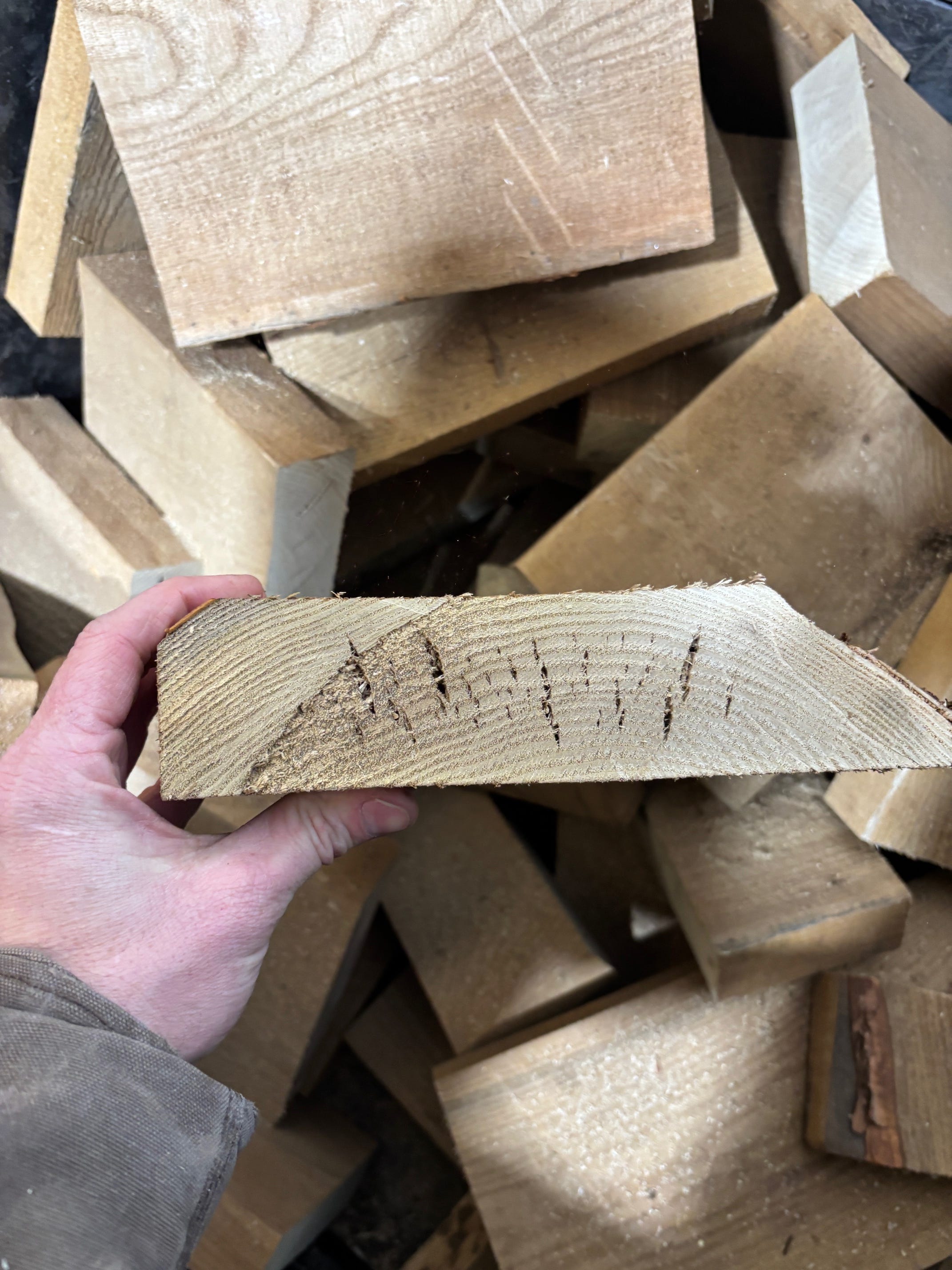
As wood loses moisture and drops below FSP the cellulose fibers dry out and change dimension. This is where the wood structure starts to shrink, crack and deform. Kind of like that sponge shriveling up on the counter as it dries out. The majority of this deformation happens between 30%MC and 20%MC. For most lumber operations; this is happening in the air-dry stage before the material ever makes it to the kiln. Which is why proper stacking and airflow control are so critical as lumber comes off the saw. As lumber drops below 20% MC most deformation (bow, twist, honeycomb etc) is caused from drying out too quickly. In an air dry scenario this could be too much sun or airflow. There is a maximum moisture loss per day that each species can withstand without deforming. In a kiln drying scenario this rate of moisture loss is controlled by what we call kiln schedules which is basically the kiln settings of temperature and relative humidity to control that rate of loss. White Oak for example can withstand a maximum of 2.5% moisture loss per day.
Wood’s balance point
But what is the target moisture and how dry is dry enough? As wood loses moisture it will settle out at a balance point where it stops losing moisture. This balance point is called the equilibrium moisture content or EMC. This balance point or EMC has a direct relationship with the relative humidity and temperature of the wood’s environment.
So how dry should the wood be? Dry enough to be at its EMC for the environment it will be used in. For outdoor uses we can use weather and climate data to know what wood EMC will be in that climate. The USDA has lots of data available on this.
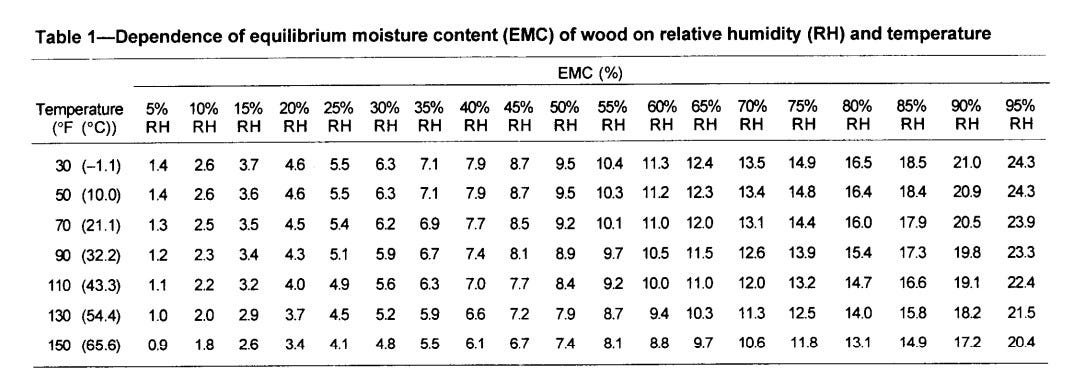
For example in Burns OR close to where my friend Justin has his shop Fernweh Woodworking the EMC for July outside is 5.9% moisture but the same piece of wood in Asheville NC during the month of July would be 15.6% moisture. The temperature and relative humidity in Burns OR or Albuquerque NM is basically a living kiln so wood can be air dried in a matter of weeks or months.
In modern American culture our homes are climatized to be between 30-50% relative humidity and around 70 degrees. This puts all the wood inside the house between 6%-10% MC. Thus most often these are the target MC %s for furniture makers. However for me here in Virginia my wife and I often have the windows open half the year so the wood in my house can be a much higher MC with no issues.
Appling it to the mechanics
The understanding of wood equilibrium is as old as woodworking itself and there are traditions that applied that understanding to the mechanical part of their woodworking. In traditional Appalachian chair making one will hear of “wet/dry” joinery. This practice in theory is that the mortise side of the joint has not reached EMC and the tenon side of the joint has. Thus the mortise shrinks around the tenon making it tighter. While this can be effective many folk craft people do not implement methods of measuring and control for consistent results. The core idea is a moisture differential to use the natural movement of the wood to keep the joint tight. Similar to how a wheelwright heats a steel band so it expands and then fits it to the wheel cooling it so that as it shrinks it pulls the wheel spokes tight into the hub.
These are simply examples to show how a better understanding of the material itself can aid us in the mechanical working of that material. We often grasp for a fixed answer without understanding the underlying concepts leaving us baffled when things don’t go as anticipated.
Understanding wood’s relationship to water and climate I believe for a woodworker is a critical understanding to have.
In my research on crofter-made furniture of the Scottish highlands, some have suggested that for staked stools and chairs they would dry the round tenons near the fire or even poke them around in warm hearth ash for a bit before putting them into somewhat green mortises for exactly this reason.
Do you have a favorite meter or two? I've been thinking I might want one. (And a good hygrometer for the shop.)